
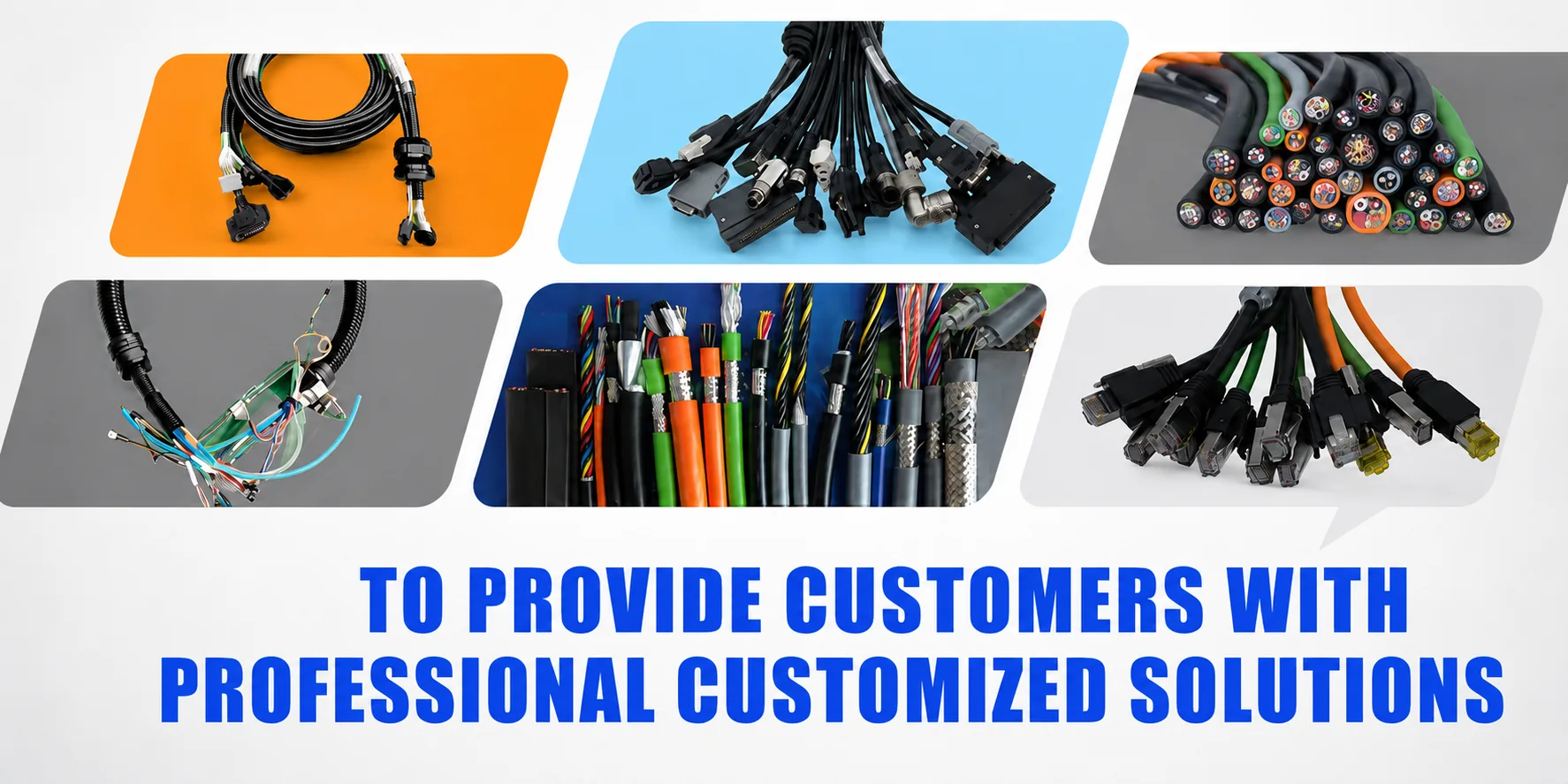
Industrial cable purchasing used to be a low-variance exercise: a bill of materials changed slowly, and price was the dominant variable. That has changed. The cable that carries power and feedback in a machine tool, a palletiser or an automated storage system now sits at the intersection of motion duty, certification scope and delivery risk. This article sets out five trends visible in 2026 for teams specifying automation cable.
1. Servo axis counts keep rising, and so does harness complexity
Machines that once used two or three servo axes now routinely ship with eight, twelve or more. Each axis needs power conductors, encoder or feedback conductors, and often a brake pair, all routed to a single moving head. The consequence is not just more cable metres. It is more connectors, more bend radii to control, and far less tolerance for a harness that is 20 mm too short.
Buyers are responding by moving from loose cable and field assembly toward pre-terminated servo harness assemblies built to a drawing. This shifts value from the cable reel to the engineering of the assembly, and it raises the importance of the supplier being able to work from a machine drawing rather than a catalogue part number.
2. Flex life ratings become a specification, not a marketing claim
Drag chain cable is now commonly described by cycle count: 1.5 million, 5 million, 10 million, 20 million, even 50 million cycles. That is useful shorthand, but it only holds if the test conditions are stated — travel distance, bend radius, speed and acceleration all change the outcome.
The practical trend is that more buyers now ask for the test basis behind a rating. A cable rated at 10 million cycles at a 100 mm travel does not behave the same way in an application that runs 600 mm of travel at 4 m/s. When comparing suppliers, ask what the rating was measured under. A supplier who can describe the test setup is usually a supplier who has actually run it.
3. Robot and cobot installations broaden the cable requirement
Robotic installations have moved well beyond large automotive cells. Collaborative robots, palletising arms, mobile platforms and vision-guided pick stations now appear in mid-sized plants. These applications combine torsion, continuous bending and high-speed motion in ways that a standard flexible cable does not tolerate.
Two requirements follow. First, cable specified for robotic duty needs to be selected for the specific motion type — continuous rotation, bending in one plane, or compound torsion — not simply labelled "robot cable". Second, the connector end must survive the same duty as the cable; a robust cable terminated into a general-purpose connector simply moves the failure point.
4. Sourcing is being split deliberately rather than concentrated
After several years of freight volatility and component shortages, many buyers have stopped treating a single-source approach as the default. A common pattern in 2026 is dual sourcing by region: one supplier for European or North American delivery, another for Asia-Pacific. The assemblies are nominally identical, which makes drawing discipline more important, not less.
Where this goes wrong is at the interface. If two suppliers build to the same drawing but interpret connector pin-out, shield termination or jacket material differently, the parts are not interchangeable. Buyers who split sourcing successfully tend to issue a tightly controlled drawing and approve samples from each site before volume release.
5. Lead time is replacing unit price as the deciding factor
For standard flexible cable, unit price still matters. For engineered assemblies, lead time increasingly decides the order. A machine builder facing a fixed commissioning date will usually accept a higher unit cost to avoid a schedule slip, because the cost of a late line start dwarfs the cable spend.
This has a practical consequence for specification: buyers are narrowing the number of distinct cable and connector types they use across a machine family. Fewer variants mean better availability. A design that uses one jacket material and two connector families across a whole machine platform is easier to keep supplied than one with eleven unique harnesses.
What this means for purchasing teams
Three practical steps follow from the trends above. First, specify by application and duty rather than by a generic category name; "robot cable" and "drag chain cable" are starting points, not specifications. Second, ask for the test basis behind any cycle-life claim, and record it. Third, keep a controlled drawing at the centre of the relationship, especially if you split sourcing across regions.
Hongxin Electrical Technology manufactures cable assemblies, servo harnesses, drag chain cable and robot cable for industrial automation, machine tool and material handling applications, supplying customers across Europe, the Americas, Southeast Asia and the Middle East. If you are reviewing cable specification for a 2026 build programme, we are glad to work from your drawing and confirm duty, certification scope and lead time.